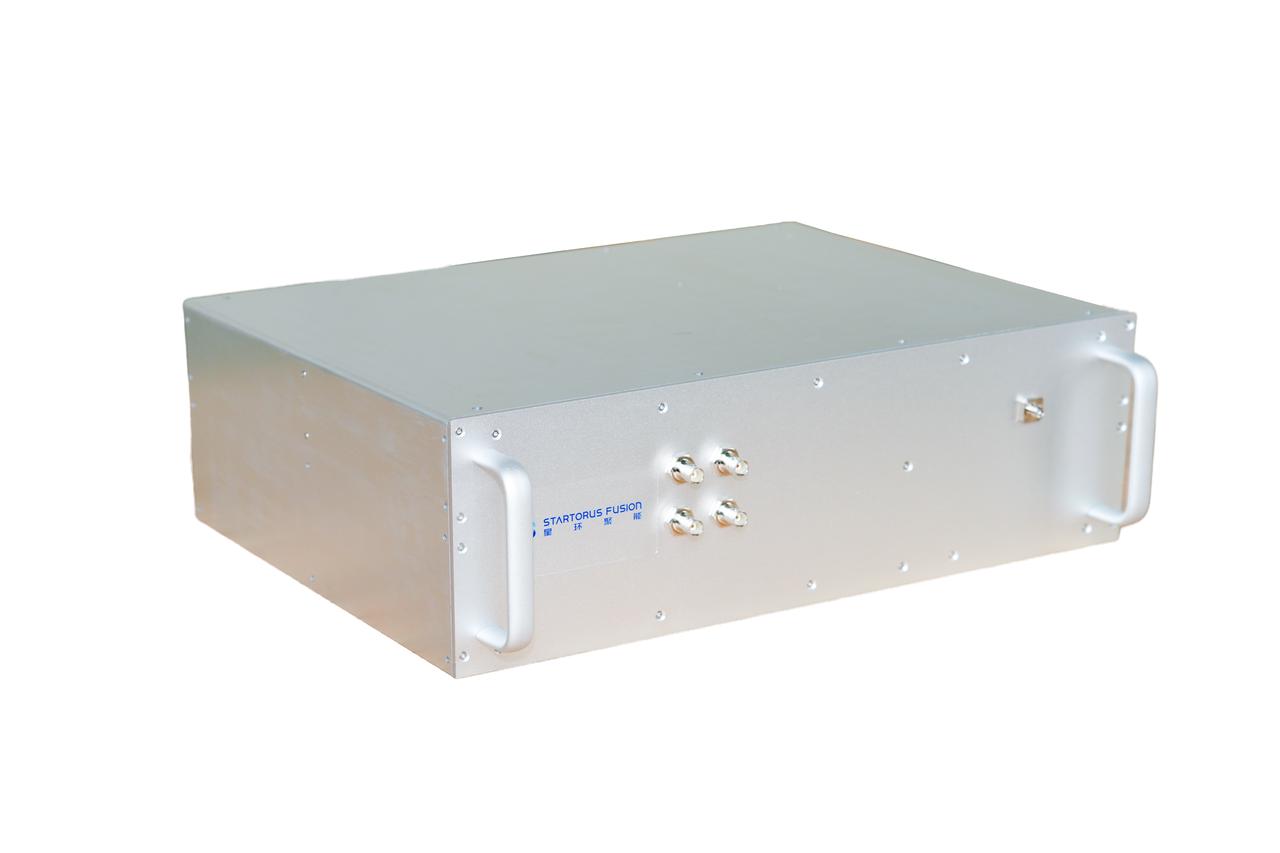
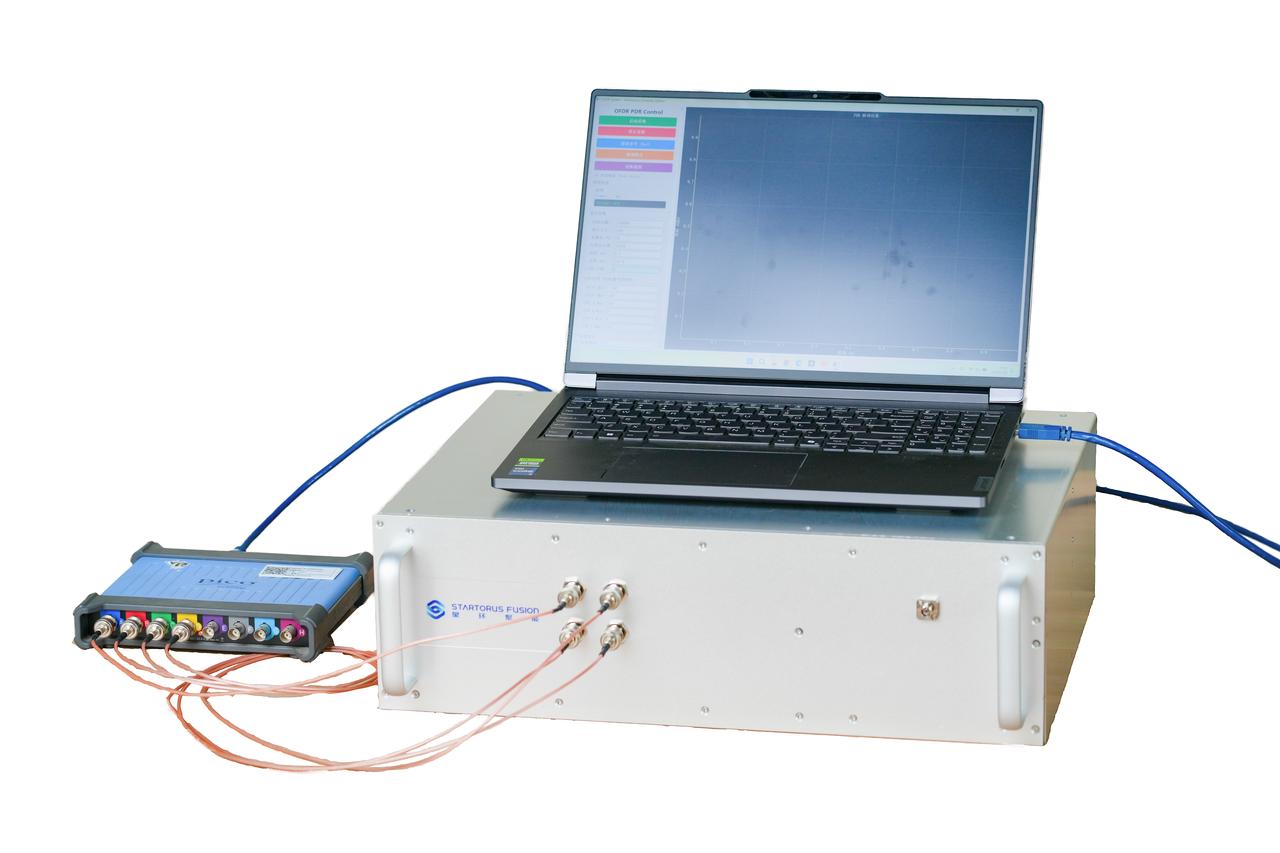
The Optical Frequency Domain Reflectometry (OFDR) Distributed Strain/Temperature Sensing System is a precision distributed measurement device engineered for extreme environments, specifically designed for fusion experiments and the structural health monitoring (SHM) of high-end equipment. Utilizing single-mode fiber (SMF) as the sensing element, the system features intrinsic immunity to strong electromagnetic interference (EMI) and radiation. It delivers a spatial resolution of 1 mm over a 100 m single-ended measurement range. Integrated with an advanced optical module and a full-pipeline GPU-accelerated demodulation architecture, it achieves a single-frame processing time of ≤100 ms. This enables the precise capture of microstrain and transient temperature anomalies, maintaining highly stable measurement performance under extreme conditions such as severe interference and cryogenic temperatures. The system is widely applicable to SHM and distributed sensing scenarios in controlled nuclear fusion, aerospace, wind power, and high-end equipment manufacturing, providing precise sensory data to ensure the safe and steady-state operation of critical assets.
| Comfiguratio | Standard Specification | Remark |
| Measurement Rang | 100 m (Customizable) | |
Max Speatial Resolution | 1 mm | Adjustable based on data acquisition card configuration. |
| Spatial Resolution | 1 mm to 20 mm (Adjustable) | Balances high spatial resolution for short distances and high stability for long distances. |
| Sensor | Compatible with various SMFS | |
| Strain Measurement Range | 10,000 με | Limited by the mechanical fracture limit of silica optical fibers. |
| Strain Measurement Resolution | 1 με | |
| Temperature Measurement Range | -270°C to 1000 °C | Standard Pl-coated fiber: ≤300 °C;Metal-coated fiber: ≤1000 °C. |
| Temperature Measurement Accuracy | 0.1 °C @25 °C | |
| Sampling Rate | 10 Hz | Test conditions: 100 m fiber, 5 mm spatial resolution. |
| Optical Connector | FC/APC | |
| Dimensions | W475 D344 H145 mm | |
| Weight | 10 kg | |
| Storage Temperature | 0~50 ℃ | |
| Operating Temperature | 10~40 ℃ |
The system is widely applicable to SHM and distributed sensing scenarios, including quench detection in superconducting magnets for controlled nuclear fusion, temperature measurement in strong EMI environments, aerospace, wind power, and high-end equipment manufacturing.
Structural Health Monitoring of Composite Materials and Smart Structures
In aerospace (e.g., wings, fuselages), wind power (e.g., turbine blades), and new energy vehicles (e.g., battery packs, carbon fiber chassis), optical fibers are embedded within composite materials or bonded to critical structural surfaces in array or network configurations. This enables the continuous, precise measurement of microstrain and temperature variations induced by mechanical loading, fatigue, thermal stress, or damage. It allows for the exact pinpointing of crack initiation sites, stress concentration zones, and delamination defects.
Distributed Sensing for Compact or Critical Infrastructure
For critical infrastructure requiring stringent monitoring within a 100-meter range—such as oil and gas pipeline valves and welds, and superconducting magnet coils and structures—SMFs are routed along the monitoring path as distributed sensors. The system not only monitors macroscopic deformation but also detects localized, early-stage anomalies with millimeter-level positioning accuracy. Examples include initial crack detection in pipeline welds and quench detection in superconducting devices.