Multi-Channel H-Bridge Controller
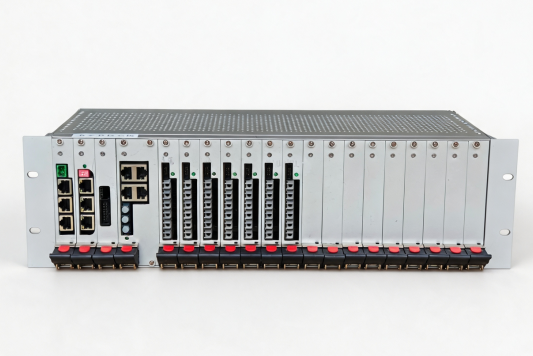
The Multi-Channel H-Bridge Controller is a high-reliability digital control core for the magnet power supply systems of nuclear fusion devices. It was originally designed for the Poloidal Field (PF) coil power supply of the SUNIST-2 device, where it controls the state of the PF power supply H-bridges in order to precisely regulate the discharge waveform. The design is portable and can also be applied to other high-power pulsed power supply control scenarios, including CS power supplies, MC power supplies, and plasma acceleration. The product uses a modular chassis-based design with an FPGA as its control core, and comprises six functional modules: the FPGA main control module, the communication module, the power supply module, the link module, the optical-port signal output module, and the signal acquisition module. All modules are interconnected through a backplane and are hot-swappable, which ensures reliable power delivery and signal transmission while keeping maintenance and upgrades convenient. In addition to controlling the output current waveform, the controller performs multi-point acquisition and real-time monitoring of voltage and current signals at various points in the power supply. The acquired signals are compared against preset thresholds to determine whether a fault exists at each monitoring point, thereby achieving fault localization and real-time protection, and safeguarding both the electrical supply and the equipment.
Multi-Channel H-Bridge Controller
The Multi-Channel H-Bridge Controller is a high-reliability digital control core for the magnet power supply systems of nuclear fusion devices. It was originally designed for the Poloidal Field (PF) coil power supply of the SUNIST-2 device, where it controls the state of the PF power supply H-bridges in order to precisely regulate the discharge waveform. The design is portable and can also be applied to other high-power pulsed power supply control scenarios, including CS power supplies, MC power supplies, and plasma acceleration. The product uses a modular chassis-based design with an FPGA as its control core, and comprises six functional modules: the FPGA main control module, the communication module, the power supply module, the link module, the optical-port signal output module, and the signal acquisition module. All modules are interconnected through a backplane and are hot-swappable, which ensures reliable power delivery and signal transmission while keeping maintenance and upgrades convenient. In addition to controlling the output current waveform, the controller performs multi-point acquisition and real-time monitoring of voltage and current signals at various points in the power supply. The acquired signals are compared against preset thresholds to determine whether a fault exists at each monitoring point, thereby achieving fault localization and real-time protection, and safeguarding both the electrical supply and the equipment.