Reference Source
DeepTech White House Releases Landmark Report Science: A New Golden Age, A Comprehensive Overhaul of U.S. 80-Year Scientific System on the Horizon
Recently, the U.S. White House Office of Science and Technology Policy released a 123-page report titled Science: A New Golden Age, putting forward proposals to reform the federal research system. Taking the 1945 landmark report Science: The Endless Frontier as a historical benchmark, it elaborates on the respective roles and division of labor among governments, universities, industrial enterprises and scientists amid a new wave of technological advancement.
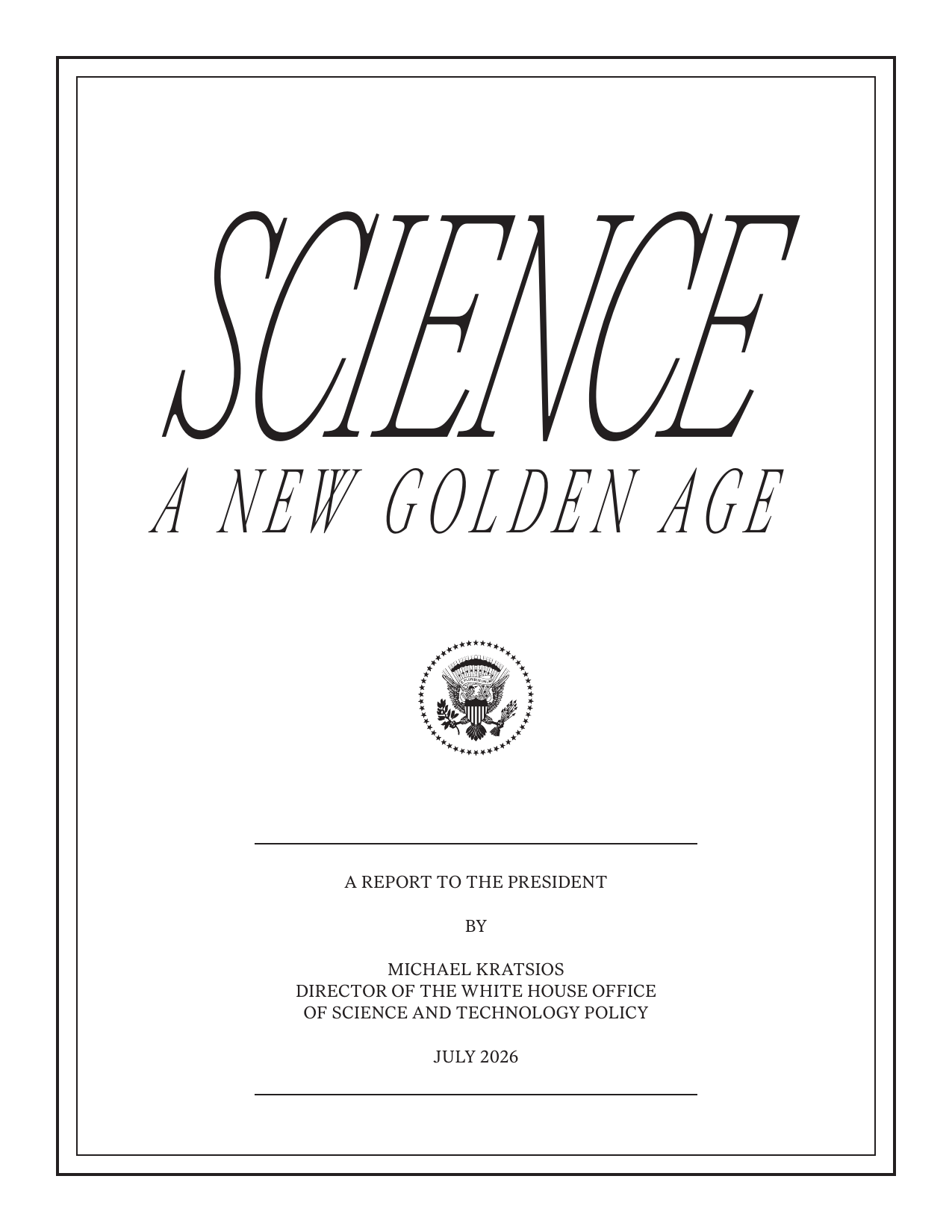
Cover of the Report Science: A New Golden Age Released by White House Office of Science and Technology Policy
For the fusion industry, the most noteworthy highlight is that commercial fusion has been designated a national mission requiring cross-agency coordination, alongside quantum computing development, lunar return missions, general-purpose robotics, and next-generation semiconductors. The report sets a target of realizing U.S. commercial fusion by the mid-2030s, placing fusion at the core of America’s new national science and technology agenda.
The report’s framing of fusion extends far beyond basic research. It addresses not merely fundamental scientific questions, but also the interlinkages among national laboratory capacity, advanced manufacturing, artificial intelligence infrastructure, critical materials, and industrial translation mechanisms. From this perspective, fusion’s standing in policy discourse has evolved from an isolated research topic into a systematic engineering undertaking.
Aligned with the mission-driven research emphasized in the report, the U.S. Department of Energy has outlined 26 national science and technology challenges covering nuclear fission and fusion, power grids, critical materials, biotechnology, quantum technologies, semiconductors, and advanced manufacturing. In March 2026, the U.S. Department of Energy announced an initial funding allocation of USD 293 million for these priorities.
A more tangible shift lies in federal funding flowing to new research entities outside universities. The National Science Foundation (NSF) has unveiled plans to invest USD 1.5 billion in X-Labs over the next decade. Such institutes typically assemble teams of 10 to 100 scientists and engineers to conduct mission-focused research targeting specific technical bottlenecks, with funding disbursed against predefined milestones. Fusion materials are explicitly listed as a priority area under this funding framework.
This overhaul of research organizational models stems from the inherent R&D characteristics of fusion energy. The report groups fusion energy with frontier fields including protein folding and quantum computing, noting that these disciplines demand interdisciplinary teams, large capital-intensive experimental facilities, and years of iterative engineering—goals difficult to deliver via traditional standalone laboratory models. Sustained long-term funding, open access to federal experimental facilities, and more flexible mission-driven organizational frameworks are specifically designed for these technology areas characterized by long development cycles, large capital outlays and heavy engineering coordination.
Artificial intelligence emerges repeatedly as a transformative enabler throughout the report. It calls for integrating scientific instrumentation, datasets, and computing resources across national laboratories to lift the overall efficiency of the U.S. research ecosystem. For fusion R&D, such integrated capabilities underpin core workflows including data analysis, experimental optimization, control system iteration, and engineering validation, shortening the feedback loop from plasma physics research to practical engineering deployment.The report sketches a restructured federal research ecosystem centered on long-range targets, cross-administration collaboration, and strengthened engineering capacity. As associated missions, programs and institutional mechanisms roll out, fusion energy will become deeply embedded within collaborative networks linking research, manufacturing and industrial resources.
The report signals that global competition in fusion no longer hinges solely on scientific breakthroughs, but increasingly on systemic capacity forged through sustained investment, large-scale engineering organization, and cross-industry coordination. Regardless of divergent policy instruments and development timelines adopted by China and the U.S., facility construction, critical component manufacturing, industrial supply chains, system integration, and long-duration operational validation remain the linchpins for translating policy aspirations into scalable industrial capabilities.
#Controlled Nuclear Fusion #Fusion Energy #Science And Technology Policy
Source of content: 白宫发布重磅报告《科学:一个新的黄金时代》,美国80年科学体系或将迎来全盘重构